Showing posts with label book. Show all posts

Thursday, April 12, 2012

Kidnapped


My dad gave me the major works of Robert Louis Stevenson for Christmas. He told me Kidnapped was the first book he remembers really engaging in as a kid. I told him I'd read it. 

Stevenson sets up a very intriguing story. (Though I don't necessarily recommend reading about his creepy uncle right before going to sleep on a night your spouse might be on night float at the hospital.)  

However, I just could not stand the main character's lack of reasoning skills! You know your uncle just tried to kill you!; why are you still going along with his suggested plans?!...you just want to hit the kid. Granted, he is only 17. And I do have the insight of knowing his story is called "Kidnapped". I guess I had reasons to think he had it coming to him. 

But besides that: why do you insist on being Alan's right hand man?! Maybe he respects you, but honestly, the man loves killing people!; I don't care if it is for his so-called just, patriotic cause. I just could not swallow the David/Alan bond. 

Besides that, my Scottish colloquialisms, dialect and political background are lacking. Due to that, I admittedly did not understand all the dialogue and even part of the plot. So that was a strike against me too.

I recognize that it was a good work of writing, very good. But it's difficult to appreciate when you're so frustrated with that flighty David Balfour. Think man, think! I guess it worked out all right for him in the end. But honestly. 

Dad, I'm impressed you enjoyed this book as a kid. Maybe it's a guy thing.

Thursday, December 15, 2011

Eats, Shoots and Leaves

You know you're a good writer when...

...you can make the subject of punctuation engaging. And humorous. I laughed out loud multiple times, discreetly trying to cover them with coughs, as I read the first chapter in the library.

And I'll admit it: since reading this, I've felt a dear friendship with the semi-colon. (And a paranoia about mis-punctuating when I write!)

Saturday, September 3, 2011

The Secret Life of Bees


I really enjoyed The Secret Life of Bees. The voice reminded me of two favorite books: The Poisonwood Bible and Walk Two Moons. All rather brilliantly done I think.

Book Club was this last Wednesday on this book. A record 22 people came. We had a fabulous discussion, not to mention yummy treats themed in honey and peaches. With a Texas Sheet Cake to boot, that I devoured. ::mmm:: Consensus: an excellent book for women's book club.

I could tell you what it's about. I could tell you what I loved* about it. Rather, I'll make a list(!):

 What I want to do because of Secret Life of Bees

 - Give daily court-convicting evidence of how much I love Seth so he never wonders
 - Find a caramel cake recipe
 - Memorize "Stopping By Woods on a Snowy Evening"
 - Take time to drink in nature's beauty
 - Bathe in a river... kidding! Just seeing if you're awake.
 - Discover how I grieve
 - Find traditions I love and other's can identify me by
 - Revel in motherhood and sisterhood
 - Choose to do the more important thing: focus on people, not worrying about painting the house pink

Thank you to whoever recommended it for Book Club!

*Loved:  vibrant writing, the 3 "calendar" sisters, Lily and her blooming, the bee quotes, the queen bee metaphor, many life lessons to consider, other elements to consider: social, political, spiritual, emotional

Thursday, September 1, 2011

Unbroken


You know you love a book when:

 3. You buy it in hardcover before you finish reading it.
 2. You read even the description of the font set, because you don't want it to be over just yet.
 1. You want to change yourself because a character inspires you.

In my top 3 must-reads for nonfiction. I kept thinking, "If this was fiction I'd say this is so unrealistic; these things could never really happen; especially not to one person." But they did.

One thing I walked away with after reading Unbroken is the realization that it's possible to not complain. Even in bad situations. Even in horrific situations. And maybe "woe is me"s are actually destructive to success. I at least know this: if Louie Zamperini didn't complain, then I can never justify complaining.

I've found that not complaining is harder than I thought, because it's often breaking social etiquette. It's easier for me to say, "Seth is still screaming all the way through nursery at 21-months-old, dangit" than "Yesterday Seth looked at me, placing his hand on my cheek in a way that said, 'I trust you and I love being with you'; I love being a mom". It's the commotion and worry of the day that's easiest to share. It's difficult to come across down-to-earth without a little complaining. Thankfully, I live around many moms who know how to share those tricky situations in a laugh-them-off way, without complaining. I need to learn the ropes of that social nook a bit more.

It runs deeper than social settings though. I know because when Ben walks in that door, what do I tell him about my day? Oftentimes I reel off the latest reason dinner is going to be a little late because of some hold-up. Couldn't I just as easily tell him the new words Seth said that day while we finish up dinner together instead of souring the welcome home moment? I could. So it's not just social pressure. It's a mindset.

There's a graceful way to stay upbeat while still looking at your challenges realistically. At least this book made me begin thinking so.

Starting this goal on the Zamperini scale is daunting; but I'll just start with baby steps. If Zamperini was running the mile in 4 minutes, I'm try to run it in 10.

Thursday, August 18, 2011

Mockingjay


Yes, I finally read it. And ya know, I actually thought it made the whole series worth reading.

I couldn't tell from the first two books if it's just meant to be a gruesome love story or if, like I was hoping, there was political substance coming. I won't spoil the ending here. But I will say it was neither the perfectly cheery ending or the perfectly black and dark ending, both of which I was dreading. Collins somehow made it happen. She tied it together with a pretty realistic message about people, power, war, pain, sacrifice, consequences and a little hope thrown in.

Thursday, July 28, 2011

Help with "The Help"

What did I tell ya? I knew Book Club would do me good. And we actually didn't even read The Help yet. It came up that it's our September book, so a few women made comments about it.

Two girls who have both lived in the South agreed that the kind of racism shown in the book continues to be alive and well there. Interestingly, one said her mother attended a public library's book club for The Help there in the South. Every person that spoke up hated it. Hit too close to home for them, according to this mother.

I was rather shocked. I was under the impression we were in the 21st century and hated only things like greenhouse gases.

I don't repeal my former comments. However, I'm willing to put my literary opinions aside to recognize that the book does contain a message we must consider.

Thursday, July 21, 2011

The Help


This book is rated with 4.46 stars on goodreads. That's just below Harry Potter and the Deathly Hallows and just above the Holy Bible. When I see a rating like I think, "Well, 137,000 people gave it 4 or 5 stars, it's gotta be amazing!" So with that I read The Help.

**contains spoilers**

Now this book, clearly, is not written to be simply enjoyed. It's historical fiction, it's a heavy subject matter. That's fine. I've been known to like the genre. And ya know, I really enjoyed the voicing. I liked the idea of the book. I loved Aibileen. I liked Minny.

But here's my beef. Skeeter is a lame protagonist. And not just because she bugged me. Which she did. But she was surprised by too obvious of things, don't you think? Examples:

 1.The toilets
She seemed surprised that Hilly wasn't thrilled to have toilets on her lawn. Obvious, that act was bound to have repercussions, no? But Skeeter seemed confused that her friends stopped talking to her and dejected to get kicked out of her place as editor.

 2. Maids in danger
After 9 months of working on this book, she has the lightbulb moment of, "This could be dangerous for the maids when people in Jackson read it."

3. Stuart
Near the end she realizes Stuart really doesn't know her. Um, where has she been for the whole book? And never did she have a moment where she was weighing her views against those of her traditionally-South boyfriend and his family and what problems that might cause to her or his father's career.

4. Mom's cancer
Skeeter didn't care much about her mom being sick until she was shocked to find out it was cancer. The reader wasn't shocked, and I was not convinced that Skeeter should have been either.


Basically, Skeeter was either way too slow on the up-take for me, or she just wasn't convincing to me as a real-life character.

And then there's the fact that she bugged me. (Am I taking this too far?) In no particular order:

 - Her priority is getting published. I was not convinced she cared about the issue she's writing about.
 - Not careful with her book or her flimsy lies to cover up her plans that would have been uncovered by any other author, I swear.
 - She's supposedly brave enough to take on this issue, but she can't get the gumption to move out or tell her parents what she thinks.
 - Exempted herself from putting her own sensitive info into the book when all the maids did.
 - She moved out of the danger zone of Jackson to have her posh New York City life and left the maids and the issues behind.

Now, if Skeeter were a side character and more time was spent on Aiblieen and Minny, I think that would have solved (almost) all my problems. But why is this meager character paired with the other stalwart and likeable two? It's hard to love a book when you don't like the protagonist.

To boot, I thought the middle of the book very slow. But with all that, ya know, I liked the book fine. But 5 stars? 5 stars?!

The subject: noteworthy. The final product: shaky. And I'm surprised that more people didn't think so.

Now I need book club to help me ease up and come around.

Wednesday, July 13, 2011

Can't Finish

It's no secret, I'm a picky reader. I'd like to think of it as being a critical reader. Or a critical thinker, that sounds even better. But perhaps it's that I overanalyze. Or expect too much or something. Whatever it is, that point will be important to consider for those of you who adored reading The Help which I'm going to be posting about shortly.

Anyhow, I've caught a more serious bug lately. I start reading a book. I love it. I think on it. In fact, I stop on each page to contemplate some thought or illusion. After one of those contemplative stops, I find I can't pick up that book again. I've lost my momentum and I can't jump back on.  


Did the thinking make me tired? Did I not take time enough to synthesize the incoming thoughts so I felt like I couldn't move on until I cemented them? Is it better to try to think and stop all together or to put off the insights to just move on and finish the book with would provide at least some other insights along the way?

Seriously, those 3 books are excellent. I recommend them. If I ever write an autobiography I hope I can write like Gaskell does about Bronte. Remen's writing helps me find my own voice and helps me consider my life in new ways. I love those stories. And I have much to learn from Susan B. Anthony's perspective and incredible fortitude. But...I just can't continue reading them right now. 

I attribute it also to my mood. Right now, no matter how great those books are, I'm thinking Harry Potter. And actually, poetry. 

The alarming thing to me is, once I get off the reading train I find it hard to get back on. I picked up The Deathly Hallows from the library yesterday in hopes that I'd get rolling. I still haven't cracked it. 

Help, I need a reading pick-me-up!

Thursday, May 19, 2011

Cranford

I read Cranford last year and liked it well enough. Imagine "Anne of Green Gables": likeable main character, small town, charming everyday life. But now subtract Gilbert, add about 50 years to her age and create for her interactions only with small town residents, other older women. Quaint; but even with Gaskell's exceptional writing, it needs a plot to get you through.

But it was originally published one story at a time in a newspaper column. Only later were they compiled into a book. So plot, that thing that keeps you reading, Cranford really doesn't have that. Though I did finish it. For Book Club's sake I think.

THAT SAID, this movie series is excellent--markedly more engaging than the book. It still contains the charm, but draws upon several other of Gaskell's writing to provide the missing plot. And with plot was also added, of course, a few sweet love stories.

Also, I think just about anything with Imelda Staunton in it has to be enjoyable. I'm watching the fifth and final episode later today so I'll see how it all ties together. But I give it my stamp of approval.

Friday, May 13, 2011

The Importance of Being Earnest


I listened to this on Librivox as I made dinner the other night. So funny, that clever Oscar Wilde. Though each so eccentric, the characters are somehow so likeable. I keep wanting to exclaim "Good heavens!" like Jack or John or Ernest, whatever you're supposed to call him. I have to see this on stage now.

Oh and if you listen to this on Librivox, I suggest "version 2". The readers are really good. All except Gwendolen that is. But Algernon, Jack and Cecily make it worth it I think.

Jane Eyre


I admire Jane. She's fictional, imaginary, and I admire her. This writing feels like the journal of a real friend. A real friend who's a brilliant writer, a courageous moralist and is just herself.
I'd never read this before. But my grandma had the 1944 Jane Eyre movie that I'd watched several times. I thought the movie was okay. But turns out it was missing about half of the book.

Bronte captures personality so vividly. Even the characters you hate you understand why they're so disagreeable. The ones I hated: her aunt, her cousins, Mr. Brocklehurst, and at times, Mr. Rochester. The ones I loved, besides Jane: Helen Burns, Diana and Mary.

Jane's relationship with Mr. Rochester I found awkward at first; with the calling him "master" and all. And I didn't quite trust him either. But I thought his foil of St. John Rivers was brilliant and masterful. It made me realize that Mr. Rochester is what she needed, because his opposite surely wasn't. Like Mozart's works (at least according to the Amadeus movie): there's just no other way it could be written.

I underlined and made notes as I read. I plan to go back and reread my notes often. And the book as a whole too. I feel more courage to do what's right and hard because of Jane. And to trust that God will guide my path as I do what He asks me to do. And that doing that will bring me the greatest happiness in ways I couldn't have expected.

Thursday, May 5, 2011

Family Tree Book

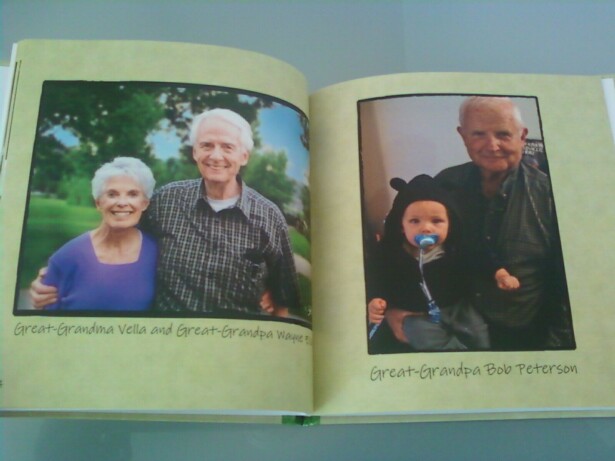
I've been so happy with the book we printed for Seth.

He loves pulling it out, especially while sitting in church, and looking at pictures of grandparents, aunts, uncles, great-grandparents, and of course, himself. It makes me happy he can start to recognize his family when he's young, even though we live far from Oregon, Utah and California!

I've printed a few books through blurb and been happy with them, but I especially liked this one through shutterfly. Probably because of the subject. And probably because we used a coupon for a free book. :?)

Thursday, April 14, 2011

The Guernsey Literary and Potato Peel Pie Society

Forgive the title if need be. Because this book is superb and you have to read it.

I'm convinced I can't write a decent enough review of it. So I'm not going to try...

But I will say, I think it must have been exquisitely difficult to weave it all together in the letter format without having holes or having the historical accounts drag. But it's very satisfyingly complete and quick-reading.

I will also say what I loved about it.

1. Authors' writing & storytelling. I love the detail-oriented freshness and personalness.
2. Juliet and Kit. I love their spunk and sass.
3. The quarky Guernsey people. I want to visit there now...along with every other reader.
4. The history. New perspective in stories about soldiers and civilians in WWII.
5. Their literary society and love of literature. I just started Jane Eyre because of Juliet's mention of it. And I soon intend to read Charles Lamb and Oscar Wilde as well.

It's just charming. And not in a feminine-only kind of way. Really.

Wednesday, April 13, 2011

Same Kind of Different As Me


I read this for March's book club and I'm continuing to think about it. It's a true story about a rich art dealer who meets a homeless guy while volunteering and how they learned to understand each other and help each other. The best chapters are Denver's, the homeless guy. He has a great voice, and his story is both so heartbreaking and uplifting.

It's a great book club book, a fast read, and has helped me consider people in new ways.

The Happiness Project

Did I never write about this one? I don't think I did.


I think Gretchen and I are a lot alike. We like to read and learn. We like to make lists. We like organizing closets. We thrill at the idea of owning a laminator. We enjoy children's literature. We both think a way to be happier is to grow or improve in some way.

I like to think that it's not moving to Italy or Bali is where we find happiness, but in improving our own living. Good thing, cause I just don't have the change to make it out to Rome any time soon.

She had tons of ideas she tried to find a little more happiness; ones I would have never thought of.

So each month had a theme of something she wanted to improve. January was "Boost Energy". Her ideas?
- sleep earlier
- toss, restore, organize
- tackle a nagging task
- act more energetic
- the more obvious, exercise consistently

She wrote blog-style about how she implemented each of these, how she felt, what didn't work, what did. It was very real-life and I didn't feel like I had to be superwoman to find a little more happiness.

The chapter I felt like I needed most: Play and Leisure. I know. I'm one of those people... The question "What is fun for me?" perplexed me at first. But by the end of the chapter I felt empowered to find fun in whatever interests me: even if it's only sudoku or a free lecture at the library.

By the end of the book I felt like she was a little tired with trying to be so proactive. I got a little tired by the end myself. But I still feel like I finished the book armed with good, do-able happy-making ideas.

Friday, March 18, 2011

Wild Swans: Three Daughters of China


You know when I don't want to put a book down to get a brownie in the kitchen that it's something worth reading. Truly, no fiction can compare with reality in this Chinese family's biography. The author tells the stories of her grandmother, mother and her own and the great changes in China during these 3 generations.

Grandmother: bound feet, married off as concubine to a warlord
Mother: survived civil war, active member of communist party
Author: child during Mao's "Great Leap Forward" and "Cultural Revolution", a Red Guard

The book is banned in mainland China, according to wikipedia, and for good reason. It describes what actually happened under "Chairman Mao". It gave me a whole new perspective on agency, democracy, education and fear.

There's really no way to say enough about this book and about Mao or China, so you'll just have to put it on your to-read list.

Thursday, March 17, 2011

North and South


You want to read a good book? Choose North and South by Elizabeth Gaskell. She's half Jane Austen, half Charles Dickens and, in her own right, a brilliant writer.

So many social, economic and moral issues addressed: poverty, social classes, urban and rural differences, industrialization, strikes, death, faith, honesty, vanity, compassion, work, diligence. Plus it's beautiful writing that puts you right into the minds of Margaret Hale and John Thornton. I admire them both, and feel inspired to be a kinder, more hard-working person after knowing them!

I hope to be receiving this book for my upcoming birthday--I want to reread often!

Tuesday, March 8, 2011

A Tale of Two Cities

I, shockingly, loved reading A Tale of Two Cities. When I finished it, my heart was racing, I declared it was the best book I ever read, and I actually started a list of possible essay topics. Nerdy I know. No, I didn't write the essay. But you know a book is powerful when it makes you want to write an essay, yeah?

But as far as giving an adequate blog description here, I've been waiting for inspiration to strike. That was two months ago, and I'm still waiting. I figure better late then never, and better inadequate then altogether absent. So here's what I've got:

I say shockingly because I formerly thought it was the most boring book on the planet. You see, I "read" it in high school. The only thing I remembered about it was a page long description of a door and that someone dies at the end. I didn't even remember what two cities Dickens was talking about. (How embarrassing.) I realize in retrospect that I was lost in the first few pages, decided then I didn't like the book, so skimmed the rest of it. And my teacher unfortunately didn't help. He taught us to memorize facts he stated: Soho = utopia; footsteps = foreshadowing. Does that help someone love a book? No.

So when I scoffed at when my husband Ben told me it was perhaps his favorite book he made me vow to read it. So we actually started reading it together outloud. He explained a few key points in the beginning and clued me in on the characters to remember. Armed with those facts, I found I couldn't put it down.

Though long-winded, Dickens' style is unmatched in showing the reader. A textbook could summarize the French Revolution with "the peasants were poor and hungry because the upperclass had all the money so the peasants revolted." But Dickens makes you feel starving, he makes you feel dirty and desperate. Then his description of the marquis having his 4 chocolate attendants and later unapologetically running over a child in his coach makes you hate him and everyone like him. But then the revenge is so ugly and heartless you realize how black the French Revolution was.

One line in-particular keeps haunting me. After the peasants riot and accomplish the most savage kind of murders, they return to their children at home, "wailing and breadless". These people killed for self-appointed justice. Was their situation helped? No, they returned to the same hunger, the same problems, to the same poor children, but now with blood on their hands; now not the same pitiful parents, but merciless butchers. In my mind they killed all love within them that their children needed when they put down their babies and went marching to the death drums. Chilling. In contemplating these things I said a small silent prayer that my heart would be guarded against marching away from my children for any kind of self-fulfillment not in their best interest.

Then, of course, there is such good in many characters too! I just love Mr. Lorry, Dr. Manette, Lucie, Charles Darney, Sydney Carton and Miss Pross. I even kind of like Jerry Cruncher by the end. I love their individuality. I love their courage and loyalty and hope. And then the way Dickens' weaves everyone's story together is truly incredible. And all with gorgeous language and striking analogies.

It made me consider how I treat others; others I like and others I don't. It made me consider what sacrifices I'm willing to make. It made me thankful for the peace and freedom I enjoy. It made me contemplate the current problems of wealth and poverty. It made me want to be generous and kinder. It made me want to know history and current events and be a more active citizen. It really changed me I think. It is truly a great work.

If you've never read it or never appreciated it, I recommend trying it. Maybe with Sparknotes for the first few chapters. (And maybe not outloud, as the violence is hard enough to stomach while reading silently.) I only wish I could hold some kind of virtual book club to discuss it with you!

Sunday, October 24, 2010

Emma


In contrast, I just finished Jane Austen's Emma. What gorgeous language! You just want to speak it outloud. To illustrate the brilliance of her writing I found a passage about the most boring subject I could: the weather.

The evening of this day was very long, and melonchony, at Hartfield. The weather added what it could of gloom. A cold stormy rain set in, and nothing of July appeared but in the trees and shrubs, which the wind was disspoiling, and the length of the day, which only made such cruel sights the longer visible...

The weather continued much the same all the following morning; and the same loneliness, and the same melonchony, seemed to reign at Hartfield; but in the afternoon it cleared; the wind changed into a softer quarter; the clouds were carried off; the sun appeared; it was summer again.With all the eagerness wuch a transition gives, Emma resolves to be out of doors as soon as possible. Never had the exquisite sight, smell, sensation of nature, tranquil, warm, and brilliant after a storm been more attractive to her. She longed for the serenity they might gradually introduce. p. 382, 384

Beautiful, no? I really liked Emma. I'd seen the Gwyneth Paltrow movie several times before I'd read it. Which, really, kind of ruined my own imagination in reading. But it's such a well done movie--Mrs. Elton is so perfectly obnoxious, Mr. Knightley so likeable, Emma so redeemable--I hold no grudges.

However, the movie just doesn't do the end of the book justice. Austen ties it together so beautifully. It isn't a Cinderella ending. You know the details, you see how it works out. I like that. Bravo Austen, bravo!

Poor Writing

Boy does reading poorly written books make me appreciate good writers. I recently read (the first 50 pages) of a short book for book club. It was a written 1960s version of "The Office": supposedly funny goings-on of an office building. It was laughably bad. It makes me realize I should never author a book. I'm sure I'd get a taste of my own medicine.

Don't you worry, I'll illustrate.

Enter
Vague, Cliche, and Needlessly Wordy.

1:
"The building, because of its affinity for small and nonglamorous individual businesses, was usually not given to many or frequent visits by persons of renown or high community status and prestiage.

As is true of any city or town, there are always a few families that go back to the roots of a community, became wealthy, hence well known."

2:
"Once in the elevator, her domesticated carnivore [he means dog] would be encouraged to leap into her arms and to thus be saved from possible sudden elevator irregularities in transit that might shock its delicate musculature. Together, thus joined, they would reach the proper floor where our podiatrist conducted his extremity based ministrations."


Once he called the elevator a "vertical vehicle" I had to put the book down. You just feel embarrassed for the guy. If you were wondering, he was a businessman who worked in aforesaid office building. And his small and nonglamorous business must not have raked in enough for him to hire an editor. Hence (a favorite of his) the quality.
Related Posts Plugin for WordPress, Blogger...